What Is Trading?
A clear, honest introduction to trading: what it really means, how it differs from investing, the main styles and time horizons, why most traders lose, and what it takes to do it responsibly.
Before this, read
Introduction
If investing is the patient art of owning productive assets for years, trading is its faster, more intense cousin: buying and selling over much shorter horizons to profit from price movements themselves. Trading is what most people picture when they imagine "the markets" — flashing screens, rapid decisions, fortunes made and lost. That image is partly true and deeply misleading.
This lesson explains what trading actually is, how it differs from the investing you have already learned about, the main styles and their time horizons, the tools traders use, and — crucially — the sobering reality of how hard it is to do profitably. The aim is not to glamorise trading or to dismiss it, but to give you an honest, clear-eyed understanding so you can decide whether, and how, it fits into your financial life. It is the natural counterpart to What Is Investing? and sets up the direct comparison in the next lesson.
Quick Definition
Trading is buying and selling financial assets relatively frequently, aiming to profit from shorter-term price movements rather than long-term ownership.
The defining features are frequency and horizon. Where an investor might buy a fund and hold it for thirty years, a trader might hold a position for thirty minutes, three days, or three weeks, then close it and look for the next opportunity. A trader is less concerned with whether a business is a wonderful long-term enterprise and more concerned with where its price is likely to go next. Trading treats price movement itself as the product.
Why Trading Exists
Trading exists because prices move, and movement creates opportunity — and risk. Markets need a constant flow of buyers and sellers to function: someone has to take the other side when an investor wants to buy or sell. Traders, by stepping in and out frequently, provide much of that liquidity, helping prices stay continuous and markets efficient. In exchange for taking on risk and providing this service, skilled traders can, in principle, be rewarded.
But trading also exists because it is alluring. The promise of quick profits, the intellectual challenge of forecasting, and the sheer excitement of active participation draw millions of people in. It is important to separate these two truths: trading serves a genuine economic function, and it is also marketed relentlessly to people for whom it is unlikely to end well. Holding both ideas at once is the beginning of wisdom about trading.
Beyond liquidity, the collective activity of traders performs price discovery — the continuous process by which markets settle on a price that reflects all available information. When new information arrives — an earnings surprise, an economic report, a geopolitical shock — it is traders, reacting and competing, who move the price to a new level. A long-term investor benefits enormously from this even if they never trade: it means that when they buy or sell, the price they get is generally fair and reflects the market's best collective judgement. So the patient investor and the active trader are not opponents; the trader's restless activity is part of what makes the investor's calm, infrequent transactions efficient. Understanding this symbiosis helps explain why markets need both temperaments — and why most individuals are far better suited, financially and emotionally, to the investor's role.
How Trading Differs From Investing
Because you already understand investing, the cleanest way to grasp trading is by contrast. The two activities share a marketplace but differ in almost every other respect.
An investor's returns come mostly from the long-term growth of the assets they own — the economy doing its work over decades. A trader's returns come from being right, more often than not, about short-term moves, after costs. That is a fundamentally harder game: the investor is riding a long-term upward tide, while the trader is trying to repeatedly out-guess a crowd of other motivated, often professional, participants. The next lesson, Investing vs Trading, examines this trade-off in depth; for now, the key point is that trading demands far more skill, time and emotional control for a far less certain reward.
The Main Styles Of Trading
"Trading" is an umbrella term covering several styles, distinguished mainly by how long positions are held.
- Scalping — the shortest style, holding positions for seconds to minutes and aiming for many tiny profits. Extremely demanding, dominated by professionals and algorithms, and effectively impossible for most retail participants to do profitably.
- Day trading — opening and closing positions within a single day, never holding overnight to avoid the risk of news while the market is closed. It requires intense, full-time focus, and is where many retail beginners (often unwisely) start, drawn by its visibility online.
- Swing trading — holding for several days to a few weeks to capture a "swing" in price. More forgiving of time than day trading — you are not glued to a screen — but still active and demanding of analysis and discipline.
- Position trading — holding for weeks to months based on a longer trend. This style sits closest to the boundary with investing, and the line between a long-term position trade and a short-term investment can genuinely blur.
As the horizon shortens, the pace, stress and cost of trading rise sharply, and the influence of luck on any single trade grows relative to skill. Longer-horizon styles give analysis more time to play out and involve fewer transactions, which is one reason beginners — if they trade at all — are usually steered toward swing or position trading rather than the frantic, professional-dominated world of scalping and day trading.
Who Is On The Other Side?
Every trade has two sides: when you buy, someone sells to you, and vice versa. A sobering question every trader should ask is who is taking the other side of my trade, and why are they so happy to? The market is not a passive backdrop; it is a crowd of participants with wildly different resources and motives.
At one end sit professional and institutional players: investment banks, hedge funds, proprietary trading firms and market makers, many running sophisticated algorithms on ultra-fast connections, staffed by teams of quantitative researchers, with access to data and tools no individual can match. At the other end sit retail traders — individuals on apps, trading their own money. In between are pensions, funds and corporations transacting for their own reasons.
When a retail trader buys a stock expecting a quick pop, the seller may well be an algorithm that has calculated, across millions of similar situations, that selling here is profitable. This does not make the game rigged, but it does make it competitive in the extreme. You are not playing against "the market" as an abstraction; you are, trade by trade, pitting your analysis against some of the best-resourced operators in the world. Recognising this is not meant to discourage, but to instil realism: an edge, if you have one, has to be good enough to beat that company.
The Tools Traders Use
Traders lean on two broad analytical approaches, often in combination:
- Technical analysis studies the price chart itself — patterns, trends, support and resistance, volume and indicators — on the premise that price action reflects all known information and tends to repeat. Because it is about timing and price behaviour, it is the dominant toolkit for shorter-term traders. (Ironclad covers these tools in depth in the Technical Analysis curriculum.)
- Fundamental analysis assesses the underlying value of an asset — a company's financials, an economy's health — to judge whether something is mispriced. Investors rely on it heavily; traders use it more selectively, often to understand why a price might move around events like earnings.
Beyond analysis, traders depend on order types (market, limit, stop) to control entries and exits, and increasingly on technology and data. None of these tools is a crystal ball; they are ways of structuring decisions under deep uncertainty.
The Reality: Why Most Traders Lose
Here is the part the marketing leaves out, and it is the most important thing a beginner can know. The large majority of active retail traders lose money or underperform a simple buy-and-hold index over time. This is not an opinion; it is one of the most consistent findings in financial research across many markets and decades.
Several forces conspire against the trader:
- Costs compound against you. Every trade crosses a spread and may incur commissions; frequent trading multiplies these into a heavy, recurring drag. Short-term gains are also often taxed more harshly than long-term ones.
- You are competing with professionals. On the other side of your trade sits, frequently, a well-resourced institution or algorithm with better data, speed and information. Retail traders are, on average, the slower money.
- Psychology sabotages skill. Fear and greed push traders to sell winners too early, hold losers too long, and chase whatever just moved. The short time frame amplifies every emotional impulse.
- Variance masquerades as skill. A few lucky wins can convince a beginner they have an edge they do not have — right up until the losses arrive.
None of this means no one succeeds at trading. A minority do, typically through years of disciplined practice, rigorous risk management, and a genuine, hard-won edge. But the honest base rate is humbling, and any introduction that fails to say so is doing the reader a disservice.
A worked example of the cost drag
The cost problem deserves real numbers, because it is invisible until you add it up. Suppose a trader makes just two round-trip trades a week — modest for an active trader — on a £10,000 account, and each round trip costs a combined 0.2% in spread and fees (often more for smaller or less liquid instruments). That is 0.4% a week, roughly 20% a year in costs alone, before a single losing trade. To merely break even, this trader must out-trade the market by 20 percentage points a year — a bar even most professionals cannot clear. A buy-and-hold investor in the same year pays almost nothing in comparison. This is why the question "how often do you trade?" is, for most people, really the question "how much of your return are you giving away?"
What Would An Edge Even Look Like?
Profitable trading requires an edge — a genuine, repeatable reason your trades should be profitable on average after costs. This is a high bar, and naming it clearly helps cut through the fantasy. An edge is not a hunch, a hot tip, or a pattern you noticed on a handful of charts. It is a statistically real advantage that persists across many trades.
Edges generally come from one of a few sources: speed (being faster than others to act on information — essentially unavailable to retail), information (knowing something the market hasn't priced — often illegal if it's material and non-public, otherwise very hard to obtain), or analysis and discipline (interpreting available information better, and executing a sound plan without emotional error, more consistently than the crowd). For the realistic retail trader, only the last is even potentially open — and it must be large enough to overcome the cost drag and the professional competition described above.
Crucially, an edge must be measured, not assumed. This means keeping meticulous records and judging results over a large enough sample to distinguish genuine skill from luck. Many traders feel they have an edge after a good month; far fewer can demonstrate one over hundreds of trades. The discipline to demand that proof from yourself — and to stop, or stay small, until you have it — is itself one of the rarest and most valuable trading skills.
Trading Responsibly
If, knowing all this, you still want to explore trading, a few principles separate responsible experimentation from gambling:
- Treat it as a skill to learn slowly, not a shortcut to riches. Expect a long apprenticeship and early losses.
- Risk only money you can afford to lose, entirely separate from your long-term investments and emergency fund.
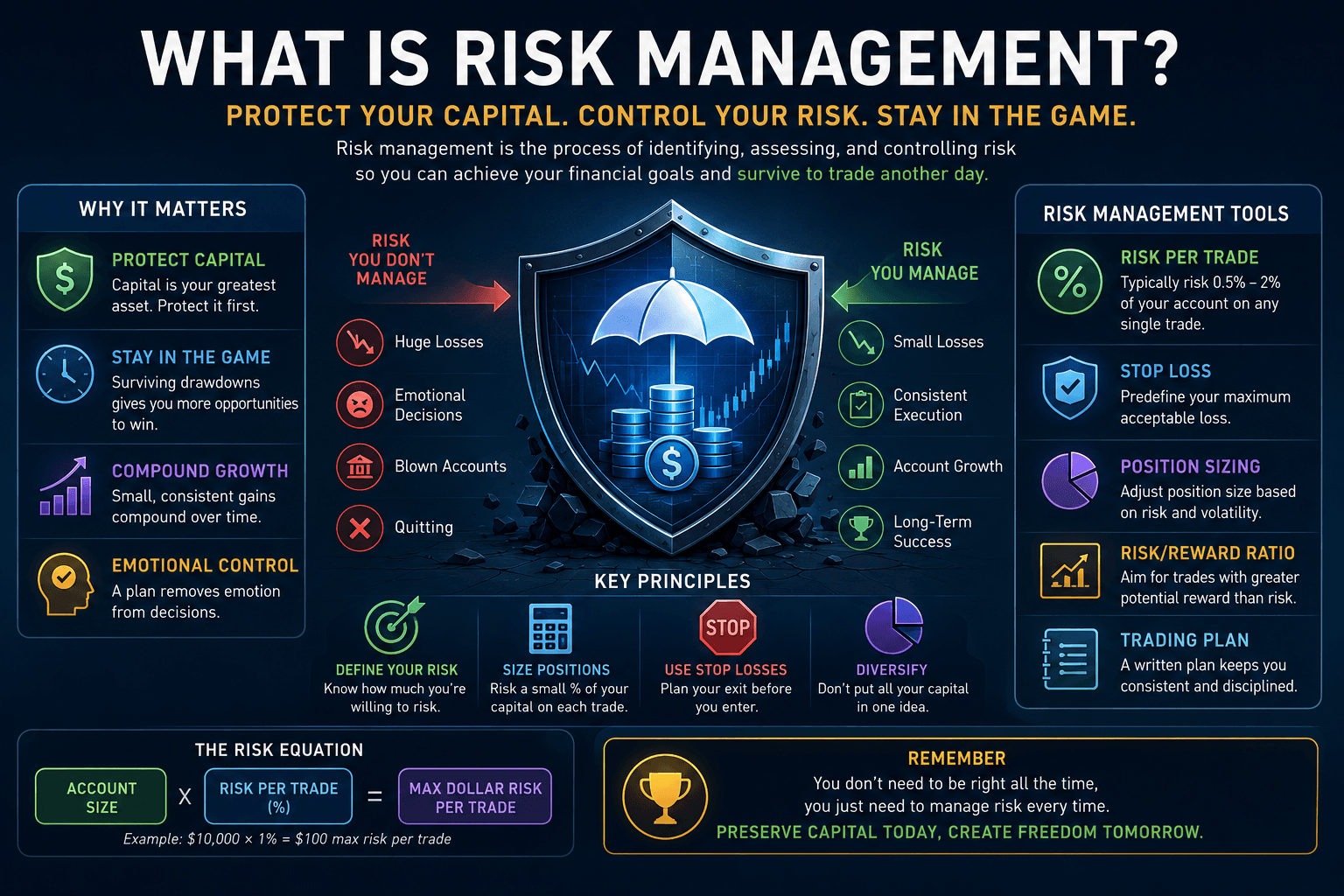
- Use strict risk management — small position sizes, predefined exits — so no single trade can do serious damage. (See What Is Risk Management?.)
- Keep records and review honestly, distinguishing genuine skill from luck.
- Never confuse trading with investing. Your long-term wealth should rest on the patient, diversified investing approach, with trading — if you do it at all — as a small, ring-fenced, high-risk activity.
Is Trading Just Gambling?
This is a fair and important question, and the honest answer is: it depends entirely on how it is done. There is a real spectrum between skilled trading and gambling, and many retail traders sit closer to the gambling end than they realise.
Gambling means taking risk with a negative expected value, usually for excitement, with outcomes driven by chance and no durable edge — buying a stock because it's "going up," chasing a tip, or trading on a feeling. Skilled trading, by contrast, means taking calculated risks with a measured, positive edge, sized carefully, executed with discipline, and reviewed honestly. The activities can look identical from the outside — both involve buying and selling and watching prices — but they are worlds apart underneath.
The uncomfortable truth is that the apps, the gamified interfaces, the confetti animations and the social-media culture around trading often nudge people toward the gambling end: frequent, emotional, undisciplined activity that feels like skill but behaves like a casino. The dividing line is not the instrument but the process: Do you have a measured edge? Do you manage risk? Do you act on a plan rather than a feeling? If the answers are no, then whatever it is called, it is functionally gambling — and should be treated with the same caution, kept tiny, and never confused with building wealth.
Common Misconceptions
- "Trading is a reliable way to get rich quickly." The evidence is overwhelmingly against this; most lose, and quick riches are the rare exception, not the rule.
- "Trading and investing are the same thing." They share a marketplace but differ in horizon, activity, skill required and source of return.
- "More trades means more profit." Usually the opposite — more trades means more costs and more chances to make a mistake.
- "If I just find the right strategy, I'll win." No strategy survives poor risk management and undisciplined psychology; the trader matters more than the system.
Real-World Application
Picture two people who each set aside £5,000 for the markets. The first treats it as long-term investment money, buys a diversified fund, and largely leaves it alone for years. The second decides to day-trade it, drawn by videos promising fast gains. A year later, the investor's pot has quietly tracked the market, while the trader — after dozens of trades, spreads, fees and a few painful emotional decisions — has more often than not fallen behind, despite vastly more effort and stress. This is the typical, well-documented outcome. Understanding what trading really is — and how steep its odds are — is precisely what lets you make that choice deliberately, rather than being sold a fantasy.
Key Takeaways
- Trading is frequent buying and selling to profit from short-term price moves, with horizons from seconds to weeks.
- It differs from investing in horizon, activity, focus and source of return — and demands far more skill, time and discipline.
- Styles range from scalping and day trading to swing and position trading; shorter horizons mean more stress, cost and luck.
- Traders use technical and fundamental analysis, but no tool removes the deep uncertainty.
- Most active retail traders underperform a simple buy-and-hold index after costs — the honest base rate.
- If you trade at all, do it responsibly and ring-fenced, never confusing it with your long-term investing.
Finished this lesson? Track your progress.
Next lesson
Continue learning
Investing vs Trading
Related topics
Ironclad Research provides educational content only. Nothing on this platform is financial advice, a recommendation, or an offer to buy or sell any security. Always do your own research and consider professional advice before making financial decisions.